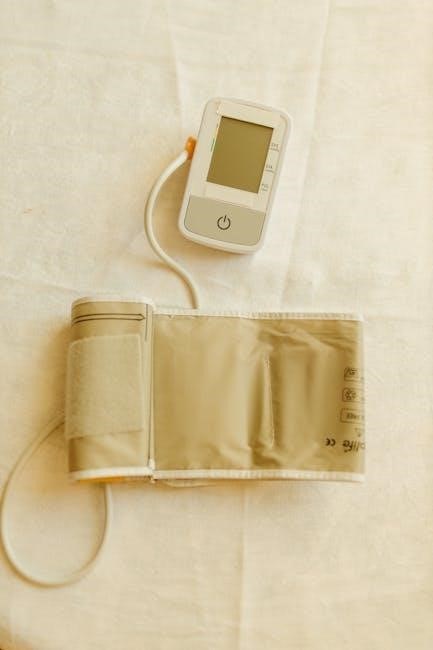
Omron Blood Pressure Manual: A Comprehensive Guide
Omron blood pressure monitors offer convenient at-home health tracking, requiring careful setup and usage for accurate readings; this guide details essential information.
Understanding your Omron device, from initial setup to interpreting results, is crucial for effective blood pressure management and overall wellness.
This manual provides insights into features like irregular heartbeat detection and memory storage, alongside troubleshooting common issues for optimal performance.
Understanding Omron Blood Pressure Monitors
Omron blood pressure monitors utilize oscillometric technology, detecting blood flow changes within arteries during inflation and deflation of the cuff. This method provides a non-invasive way to measure systolic and diastolic pressures.
These devices are designed for home use, empowering individuals to proactively monitor their cardiovascular health. The OMRON M3 Comfort, for example, is a fully automatic upper arm monitor known for its ease of use.
Proper understanding of the monitor’s components, like the cuff and display, is vital. Regularly consulting the instruction manual specific to your model ensures safe and accurate operation, contributing to effective health management.
Types of Omron Blood Pressure Monitors
Omron offers a diverse range of blood pressure monitors to suit individual needs. Primarily, these fall into two categories: upper arm and wrist monitors. Upper arm models, like the OMRON M3 Comfort, are generally recommended for consistent accuracy due to their position relative to the heart.
Wrist monitors provide convenience and portability, ideal for travel or individuals with limited arm mobility. However, proper wrist positioning is crucial for reliable readings.
Beyond these, Omron also features Bluetooth-enabled models for seamless data transfer to smartphones, facilitating long-term tracking and sharing with healthcare professionals.
Upper Arm vs. Wrist Monitors
Upper arm blood pressure monitors, like many Omron models, are typically considered more accurate as they measure closer to the heart, minimizing the impact of peripheral resistance. They require a stable arm position during measurement.
Wrist monitors offer portability and ease of use, but accuracy is highly dependent on correct wrist placement – at heart level – and immobility during readings.
While wrist monitors are convenient, upper arm devices are often preferred for individuals with certain medical conditions or those needing consistently precise measurements. Choosing depends on lifestyle and health needs.
Choosing the Right Monitor for Your Needs
Selecting the ideal Omron blood pressure monitor depends on individual health requirements and lifestyle. Consider if you need advanced features like irregular heartbeat detection or Bluetooth connectivity for data tracking.
For general wellness monitoring, a basic upper arm model may suffice. Individuals with diagnosed hypertension or other cardiovascular conditions might benefit from a more sophisticated device with memory storage and averaging functions.
Wrist monitors are suitable for those prioritizing portability, but ensure proper technique is followed. Evaluate cuff size options to guarantee accurate readings; a correct fit is paramount.
Setting Up Your Omron Blood Pressure Monitor
Omron monitor setup involves installing batteries, selecting the correct cuff size, and familiarizing yourself with the display panel for accurate and reliable measurements.
Installing Batteries and Power Source
Omron blood pressure monitors typically operate using batteries or an AC adapter, depending on the model. To install batteries, locate the battery compartment, usually on the back or side of the device. Insert the specified type and number of batteries – often AA or AAA – following the polarity markings (+ and -) inside the compartment.
Ensure the batteries are securely in place. Some Omron monitors also support AC adapter power; connect the adapter to a power outlet and the monitor’s DC input jack. When using both, the adapter usually takes precedence. Always refer to your specific model’s manual for detailed instructions regarding battery type and adapter specifications.
Correct Cuff Size Selection
Choosing the right cuff size is critical for accurate blood pressure readings. An incorrectly sized cuff can lead to falsely high or low results. Measure your upper arm circumference to determine the appropriate cuff size; Omron typically offers cuffs in small, medium, and large sizes.
A cuff that’s too small will cause an artificially high reading, while a cuff that’s too large will result in a falsely low reading. Consult the Omron sizing guide included with your monitor or on their website. Ensure the cuff wraps comfortably around your arm, leaving a small gap.
Understanding the Monitor’s Display
Omron blood pressure monitor displays vary by model, but common elements include systolic and diastolic blood pressure readings, pulse rate, and indicators for errors or irregularities. The systolic number represents pressure when your heart beats, while diastolic shows pressure between beats.
Many Omron monitors feature a color-coded hypertension indicator, visually representing your blood pressure category based on established guidelines. Some models display a heart symbol if an irregular heartbeat is detected during measurement. Familiarize yourself with the specific icons and symbols on your monitor’s display for accurate interpretation.

Taking Accurate Blood Pressure Readings
Accurate readings depend on proper technique and posture; follow the step-by-step instructions carefully to minimize errors and ensure reliable blood pressure monitoring.
Consistent measurement practices, avoiding common mistakes, are vital for tracking health effectively with your Omron device.
Proper Positioning and Posture
Achieving accurate blood pressure readings with your Omron monitor begins with correct positioning. Sit comfortably with your back supported, feet flat on the floor, and legs uncrossed for at least five minutes before measurement.
Ensure your arm is supported at heart level, whether on a table or armrest. Avoid talking or moving during the measurement process, as this can artificially inflate readings.

Relax your arm and avoid clenching your fist. Proper posture minimizes interference and provides a more reliable reflection of your true blood pressure. Consistent positioning is key for tracking changes over time.
Measurement Technique: Step-by-Step
Begin by applying the correct cuff size to your upper arm, ensuring it’s snug but not too tight. Position the cuff approximately one inch above your elbow, with the artery mark aligned.
Press the ‘Start’ button and remain still throughout the inflation and deflation process. Avoid talking or moving. The monitor will automatically inflate, measure, and display your systolic and diastolic readings, along with your pulse rate.
Record your results immediately. Repeat the measurement after a short break if desired, averaging multiple readings for greater accuracy.
Avoiding Common Measurement Errors
To ensure accurate readings, avoid caffeine, alcohol, and smoking for at least 30 minutes before measurement. Always sit quietly for five minutes with your back supported and feet flat on the floor.
Don’t talk during the measurement process, and ensure the cuff is positioned correctly and at heart level. Avoid crossing your legs, as this can elevate blood pressure.
Repeating measurements after a brief pause and averaging the results minimizes errors. Incorrect cuff size is a frequent issue; select the appropriate size for your arm circumference.
Interpreting Your Blood Pressure Readings
Understanding systolic and diastolic numbers is key to assessing cardiovascular health. Categorizing readings helps determine risk levels, prompting timely medical consultation when necessary;
Regular monitoring and accurate interpretation, guided by your Omron manual, empower proactive health management and informed discussions with your doctor.
Understanding Systolic and Diastolic Numbers
Blood pressure readings consist of two numbers: systolic and diastolic, both vital for assessing cardiovascular health. Systolic pressure, the top number, measures the force against artery walls when the heart beats, reflecting the heart’s contraction. Conversely, diastolic pressure, the bottom number, indicates the force against artery walls between heartbeats, during the heart’s resting phase.
These numbers are expressed in millimeters of mercury (mmHg). For example, a reading of 120/80 mmHg means a systolic pressure of 120 and a diastolic pressure of 80. Understanding both values provides a comprehensive picture of your heart’s function and overall circulatory system health, as detailed in your Omron manual.
Blood Pressure Categories and What They Mean
Omron monitors help categorize blood pressure readings, aiding in health assessment. Normal blood pressure is generally considered below 120/80 mmHg. Elevated readings range from 120-129 systolic and below 80 diastolic. High blood pressure (Hypertension) is 130/80 mmHg or higher, categorized as Stage 1 or Stage 2 based on severity.
Hypertensive crisis exceeds 180/120 mmHg, requiring immediate medical attention. These categories, outlined in your Omron manual, help track changes and inform healthcare decisions. Consistent monitoring and understanding these levels are crucial for proactive heart health management.
When to Consult a Doctor
Omron monitors are valuable tools, but don’t replace professional medical advice. Consult a doctor if you consistently record readings of 130/80 mmHg or higher, indicating potential hypertension. Seek immediate medical attention for readings exceeding 180/120 mmHg – a hypertensive crisis.
Discuss any irregular heartbeat detections with your physician. Even with normal readings, regular check-ups are vital, especially with pre-existing conditions. Your Omron manual emphasizes that self-diagnosis is discouraged; professional evaluation is key for accurate diagnosis and treatment plans.
Omron Monitor Features and Functions
Omron monitors boast memory storage, irregular heartbeat detection, and average reading calculations, enhancing user convenience and providing comprehensive health data tracking.
These features empower individuals to monitor trends and share valuable information with their healthcare providers for informed decisions.
Memory Storage and Recall
Omron blood pressure monitors commonly feature built-in memory to store previous readings, allowing users to track their blood pressure trends over time. This is incredibly valuable for identifying patterns and assessing the effectiveness of lifestyle changes or medication.
The capacity of the memory varies by model, with some storing dozens or even hundreds of readings, often with date and time stamps. Users can easily recall these stored values directly on the monitor’s display, providing a convenient historical record.
This feature facilitates better communication with healthcare professionals, enabling informed discussions about blood pressure management and overall cardiovascular health. Regularly reviewing stored data can empower individuals to proactively manage their well-being.
Irregular Heartbeat Detection
Many Omron blood pressure monitors incorporate an Irregular Heartbeat Detection (IHB) feature, which analyzes your pulse during measurement for inconsistencies. This function doesn’t diagnose arrhythmia, but alerts you to potentially irregular rhythms that warrant medical attention.
If an irregular heartbeat is detected, the monitor will display a symbol on the screen after a reading is taken. It’s crucial to understand that this is not a substitute for a professional medical evaluation.
Consult your doctor if you frequently receive IHB alerts, as it could indicate an underlying heart condition requiring further investigation and appropriate treatment. This feature provides an extra layer of health monitoring.
Average Reading Calculation
Omron blood pressure monitors often calculate an average of your previous readings, providing a more comprehensive view of your blood pressure trends over time. This feature typically stores a specified number of past measurements – often the last 30 or 60 – and computes the mean value.
Accessing the average reading allows you to monitor changes and identify potential issues more effectively than relying on single measurements. Consistent tracking helps you and your doctor assess treatment effectiveness.
Refer to your specific model’s manual for instructions on how to access and interpret the average reading function, ensuring accurate data analysis for informed healthcare decisions.

Troubleshooting Common Issues
Omron monitors may display error codes or experience cuff inflation problems; connectivity issues can also arise with Bluetooth models, requiring manual review.
Addressing these problems promptly ensures accurate readings and continued effective blood pressure monitoring for better health management.

Error Codes and Their Meanings
Omron blood pressure monitors utilize error codes to signal potential issues during operation. Understanding these codes is vital for effective troubleshooting. For instance, an “Err” message often indicates a measurement error, potentially due to movement or an improperly fitted cuff. Code “E1” might suggest a cuff leak or disconnection, while “E2” could point to an internal system error requiring service.
Consult your specific model’s manual for a comprehensive list, as codes vary. Ignoring error messages can lead to inaccurate readings and compromised health monitoring. Regularly checking the manual and addressing codes promptly ensures reliable performance and accurate blood pressure data.
Cuff Inflation Problems
Omron blood pressure monitor cuff inflation issues can stem from several causes. A common problem is a kinked or twisted cuff tube, restricting airflow. Ensure the tube is freely connected to the monitor and isn’t obstructed. Incorrect cuff size also hinders proper inflation; a too-small cuff requires more pressure, while a too-large one may not inflate sufficiently.
If the cuff doesn’t inflate at all, check the batteries or power source. A damaged cuff bladder can also prevent inflation, necessitating replacement. Always refer to your model’s manual for specific troubleshooting steps and safety precautions.
Connectivity Issues (Bluetooth Models)
Omron Bluetooth-enabled blood pressure monitors sometimes experience connectivity problems with smartphones or tablets. First, confirm Bluetooth is enabled on your mobile device and that the Omron Connect app has the necessary permissions. Ensure the monitor is in pairing mode, as detailed in your model’s manual.
If pairing fails, try restarting both the monitor and your mobile device. Interference from other Bluetooth devices can also disrupt the connection; move away from potential sources. Check for app updates, and if issues persist, consult Omron support for assistance.
Maintaining Your Omron Blood Pressure Monitor
Regular cleaning, proper storage, and timely battery replacements are vital for maintaining your Omron monitor’s accuracy and extending its lifespan.
Cuff care, including inspection for cracks, is also essential for reliable blood pressure measurements over time.
Cleaning and Storage
To ensure the longevity and accuracy of your Omron blood pressure monitor, regular cleaning is paramount. Gently wipe the main unit with a soft, dry cloth. Avoid using abrasive cleaners or solvents, as these can damage the device. The cuff can be cleaned with a damp cloth, followed by thorough drying.
For storage, keep the monitor in a cool, dry place, away from direct sunlight and extreme temperatures. Avoid storing it in humid environments. Properly coil the cuff and store it alongside the monitor to prevent damage. Ensure the monitor is protected from dust and physical impacts when not in use.
Consistent care will maintain optimal performance.
Battery Replacement
When the low battery indicator appears on your Omron monitor’s display, it’s time for replacement. Use only new batteries of the specified type, typically AA or AAA, as indicated in your model’s manual. Always replace all batteries at the same time to prevent inaccuracies and ensure consistent performance.
To access the battery compartment, locate the cover on the back or side of the unit and gently open it. Insert the new batteries, matching the polarity (+ and -) as shown inside the compartment. Close the cover securely. Dispose of old batteries responsibly, following local regulations.
Regular battery checks are vital.
Cuff Care and Replacement
Proper cuff care extends the life of your Omron blood pressure monitor. Gently wipe the cuff with a slightly damp cloth if needed; avoid using harsh chemicals or immersing it in water. Inspect the cuff and tubing regularly for cracks, leaks, or damage. A damaged cuff can lead to inaccurate readings.
Cuff replacement is necessary if damage is detected or if the cuff no longer fits correctly. Choose the correct cuff size based on your arm circumference, as an ill-fitting cuff compromises accuracy. Omron offers various cuff sizes for purchase.
Ensure secure connections.

Omron Blood Pressure Monitor Manual Resources
Access your specific Omron model’s manual online via the official Omron website for detailed instructions. Omron support and customer service are readily available for assistance.
Finding Your Specific Model’s Manual Online
Locating the correct manual for your Omron blood pressure monitor is straightforward. Begin by visiting the official Omron Healthcare website. Navigate to the “Support” or “Manuals” section, typically found in the website’s footer or main navigation menu.
You’ll likely be prompted to enter your specific model number – this is crucial for accessing the right documentation. The model number is usually found on the back or bottom of your monitor, or on the original packaging. Once entered, the website will display a downloadable PDF version of your monitor’s instruction manual.
Omron provides comprehensive manuals covering all aspects of operation, troubleshooting, and maintenance. Ensure you download the manual corresponding to your exact model for accurate guidance.
Omron Support and Customer Service
Omron Healthcare offers robust customer support options for assistance with your blood pressure monitor. Their official website provides a comprehensive FAQ section addressing common questions and troubleshooting tips. You can also access direct support through their online chat feature, offering real-time assistance from a support representative.
For more detailed inquiries or technical issues, Omron provides a dedicated customer service phone line. Details can be found on their website under the “Contact Us” section.
Omron’s support team can assist with manual requests, error code explanations, and general product information, ensuring a positive user experience.