Soccer Practice Drills: A Comprehensive Plan
Elevate your team’s performance with expertly designed drills! This plan offers structured sessions,
focusing on skill development and tactical awareness for players of all levels.
Downloadable resources are available!
Welcome to the world of structured soccer training! Effective drills aren’t just about repetitive kicking; they’re about fostering a deep understanding of the game, improving technical skills, and building tactical intelligence. This comprehensive plan is designed to provide coaches and players with a roadmap to success, moving beyond basic exercises to create dynamic and engaging practice sessions.
The key to successful drills lies in progression. Start with fundamental movements and gradually increase complexity, challenging players to adapt and improve. Each drill should have a clear objective, focusing on a specific skill or tactical concept. Consider incorporating game-realistic scenarios to bridge the gap between practice and match play.
Variety is crucial to maintain player engagement and prevent plateaus. Mix up drill types, intensities, and formats to keep things fresh and exciting. Don’t be afraid to modify drills to suit your team’s specific needs and skill levels. Remember to prioritize quality over quantity – focused, well-executed repetitions are far more valuable than rushed, sloppy ones. Downloadable resources, including drill diagrams and session plans, are available to support your coaching efforts.
II. Warm-Up & Dynamic Stretching (15 minutes)
Prioritize injury prevention and performance enhancement with a thorough warm-up routine. This 15-minute sequence focuses on dynamic stretching, preparing muscles for the demands of training and competition. Avoid static stretching before activity, as it can temporarily reduce power output.
Begin with light cardio – jogging around the perimeter of the field for 3-5 minutes. Gradually increase intensity, incorporating skips, high knees, and butt kicks. Transition into dynamic stretches, such as leg swings (forward, backward, and sideways), arm circles, torso twists, and walking lunges with a twist.
Focus on movements that mimic soccer-specific actions. Include hip flexor stretches, hamstring sweeps, and ankle rotations. Encourage players to actively engage their core throughout the warm-up. A well-executed warm-up not only reduces the risk of injury but also improves flexibility, range of motion, and overall athletic performance. Remember to emphasize proper form over speed or range. Conclude with some light ball work, such as passing in pairs, to further prepare players for the session.
III. Passing & Receiving Drills (20 minutes)
Develop fundamental passing and receiving skills crucial for effective possession and attacking play. This 20-minute block focuses on accuracy, technique, and decision-making. Players will work on both short and long passing, emphasizing proper footwork, body positioning, and weight of pass.
Start with basic passing in pairs, focusing on inside-of-the-foot passes. Encourage players to maintain a soft touch and accurate target. Progress to passing with different surfaces of the foot – outside, laces – to increase versatility. Introduce receiving techniques, emphasizing cushioning the ball and controlling it with different parts of the body.
Incorporate movement by having players pass and move to create passing lanes. Add a defender to increase the pressure and challenge players to make quick decisions. Focus on communication – players should call for the ball and provide clear passing options. Emphasize the importance of first touch to set up the next action. Conclude with a passing pattern drill, incorporating multiple players and movements to simulate game-like scenarios.
IV. Short Passing Accuracy Drill
This drill hones short passing precision, a cornerstone of effective ball retention and build-up play. Players work in pairs, approximately 10-15 yards apart, focusing solely on accurate, weighted passes using the inside of the foot. The emphasis is on consistency and minimizing errors.
Setup: Mark two cones to define the passing zone. Players begin with a ball each. Execution: Player A passes to Player B, aiming for their feet. Player B controls the ball and immediately returns a pass to Player A. Repeat for 60 seconds, then switch roles. Coaching Points: Encourage players to lock their ankles, maintain a slight bend in their knees, and follow through with their passing foot towards their target.
Progression 1: Introduce a target – a small cone or marker – that players must hit with their passes. Progression 2: Add a defender who lightly pressures the passer, forcing quicker decision-making. Regression: Reduce the distance between players if accuracy is a significant challenge. Focus on quality over quantity; emphasize controlled, accurate passes over rapid-fire attempts.
V. Long Passing Range & Technique Drill
This drill develops the ability to deliver accurate long passes, crucial for switching play, launching counter-attacks, and finding teammates in space. Players practice utilizing proper technique to maximize distance and precision, focusing on body positioning and follow-through.
Setup: Divide players into pairs, positioned approximately 40-50 yards apart. Each pair needs one ball. Mark cones to designate starting positions. Execution: Player A attempts a long pass to Player B, aiming for their feet or a designated space. Player B controls the ball and returns a long pass to Player A. Repeat for 60 seconds, then switch roles. Coaching Points: Stress the importance of a firm ankle, a full leg swing, and striking the ball with the laces. Encourage players to lean forward slightly during the pass.
Progression 1: Introduce a moving target – Player B begins jogging before receiving the pass. Progression 2: Add passive defenders to simulate game pressure. Regression: Reduce the distance between players if consistent long passing is difficult. Prioritize technique and a clean strike; accuracy will improve with consistent practice.
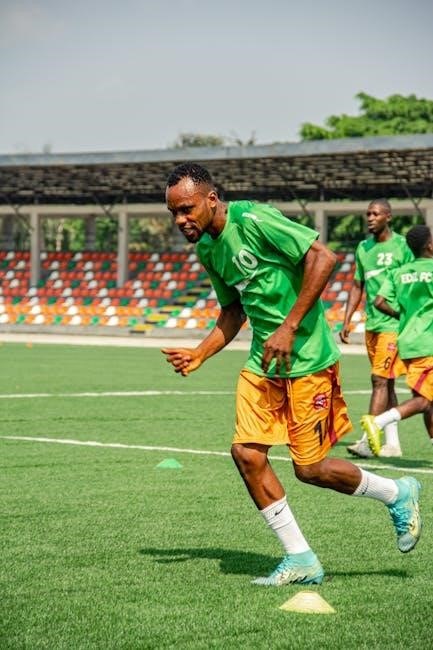
VI. Dribbling & Ball Control Drills (20 minutes)
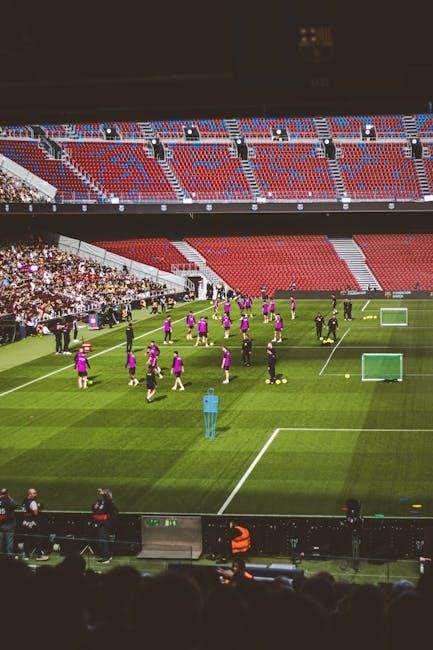
This section focuses on enhancing players’ close control and agility with the ball. Mastering dribbling is fundamental for beating opponents, maintaining possession under pressure, and creating attacking opportunities. These drills emphasize both speed and precision, encouraging players to keep their heads up and be aware of their surroundings.
The core objective is to develop comfort and confidence on the ball. Players will work on various techniques, including inside/outside foot touches, sole rolls, and changes of direction. Emphasis will be placed on using different parts of the foot to manipulate the ball effectively. Drills are designed to be progressively challenging, starting with basic control exercises and advancing to more complex scenarios involving defenders.
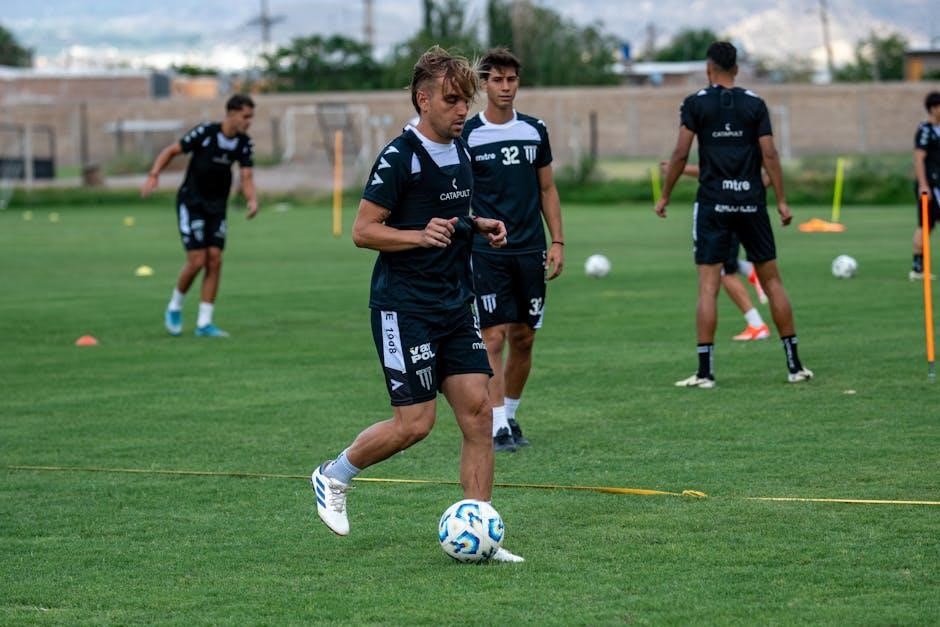
Successful dribbling requires a combination of technical skill and spatial awareness. Players are encouraged to experiment with different moves and find what works best for them. Consistent practice is key to improving dribbling ability and becoming a more dangerous attacking threat. These drills lay the foundation for advanced ball mastery.
VII. Cone Dribbling for Agility
This drill utilizes cones to create a challenging obstacle course, designed to improve players’ agility, quickness, and close ball control. Players will dribble through the cones at varying speeds, focusing on maintaining a low center of gravity and using small, precise touches. The setup involves arranging cones in a line, zigzag pattern, or square formation, depending on the desired level of difficulty.
The primary goal is to enhance players’ ability to change direction rapidly while keeping the ball under control. Players should practice dribbling with both feet, alternating touches and experimenting with different techniques to navigate the cones efficiently. Coaches should emphasize the importance of looking up and scanning the field while dribbling, even when focused on the obstacle course.
Variations can be introduced to increase the challenge, such as requiring players to perform specific moves (e.g., step-overs, scissors) between cones or adding a defender to apply pressure. This drill is excellent for developing footwork, coordination, and decision-making skills under pressure. Consistent repetition will lead to significant improvements in agility and ball control.
VIII. Shielding & 1v1 Dribbling Drill
This drill focuses on developing a player’s ability to protect the ball from an opponent while simultaneously creating opportunities to dribble past them. Players practice shielding techniques – using their body to create space between themselves and the defender – and then transition into 1v1 dribbling scenarios. The drill begins with players paired up, each with a ball, within a designated area.
One player acts as the attacker, attempting to dribble past the defender while the defender tries to win the ball. Emphasis is placed on using the correct body positioning to shield the ball, keeping it on the side away from the defender, and utilizing quick changes of direction. Players should be encouraged to use feints and deceptive movements to unbalance the defender.
Coaches should observe and provide feedback on technique, focusing on body angle, balance, and the effectiveness of shielding. Progressions can include limiting the space to increase pressure or adding constraints, such as requiring a certain number of touches before attempting to dribble past the defender. This drill builds confidence, improves decision-making, and enhances 1v1 skills crucial for game situations.
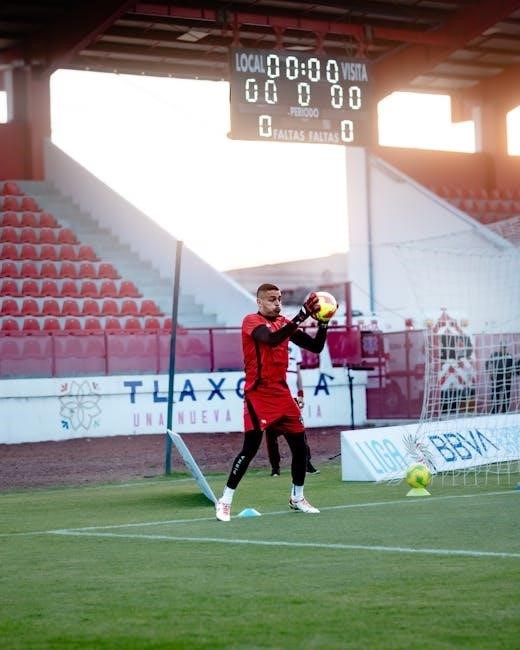
IX. Shooting & Finishing Drills (25 minutes)
This segment concentrates on refining shooting technique and improving finishing accuracy. Players will engage in drills designed to enhance their ability to strike the ball with power and precision, simulating game-like scenarios. We begin with a focus on proper foot placement, body positioning, and follow-through, emphasizing the importance of striking through the center of the ball for optimal control.
Drills will progress from stationary shooting – focusing solely on technique – to shooting on the move, incorporating passing combinations and dynamic runs. Players will practice shooting from various angles and distances, targeting specific areas of the goal. Coaches will provide individualized feedback on technique, emphasizing the importance of keeping the head down and following through with the shooting motion.
Variations will include shooting after receiving a pass, shooting under pressure from a defender, and finishing crosses from wide areas. The goal is to build confidence and develop a consistent shooting technique that can be reliably executed in game situations. Emphasis will also be placed on quick decision-making and selecting the appropriate shooting technique based on the situation.
X. Stationary Shooting for Accuracy
This drill isolates shooting technique, removing the complexity of movement and focusing purely on precision. Players position themselves at a set distance from the goal – initially close, gradually increasing the range – and practice shooting at designated targets within the goal. Emphasis is placed on consistent form: proper foot placement, ankle lock, body posture, and a smooth follow-through.
Coaches will provide visual cues and feedback on technique, correcting any flaws in form. Players are encouraged to visualize the ball’s trajectory and focus on hitting the target with accuracy. Variations include shooting at different target sizes, such as cones or specific sections of the goal, to increase the difficulty. We also incorporate shooting with both feet, promoting balanced development.
To enhance focus, players can be challenged to achieve a certain number of successful shots within a time limit. This drill builds a strong foundation for shooting technique and develops muscle memory. It’s crucial to prioritize quality over quantity, ensuring each shot is executed with proper form and intent. Regular practice of this drill will significantly improve shooting accuracy.
XI. Shooting on the Move Drill
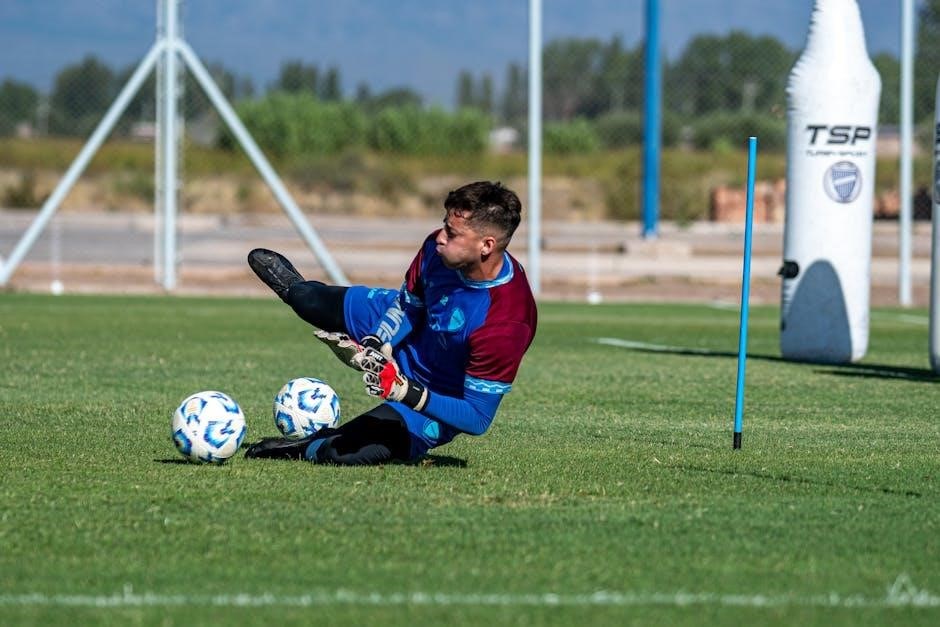
This dynamic drill simulates game-like shooting scenarios, requiring players to shoot while running onto a pass or dribbling towards the goal. Players begin with a pass from the coach or a teammate, then take a touch to control the ball and immediately shoot. The focus is on maintaining balance, coordinating footwork, and generating power while in motion. Different passing angles and speeds are used to challenge players’ ability to adjust their shooting technique.
Coaches emphasize quick decision-making and accurate shot placement. Players are encouraged to vary their shooting techniques, including laces, inside foot, and bending shots, depending on the angle and distance. The drill can be progressed by adding defenders to create pressure and simulate game conditions. We also incorporate shooting after a dribbling run, requiring players to beat a defender before shooting.
To increase intensity, players can be challenged to score within a limited number of touches. This drill develops the ability to shoot effectively under pressure and improves overall game awareness. It’s vital to prioritize proper technique even when moving at speed. Consistent practice will enhance shooting accuracy and power while on the run.
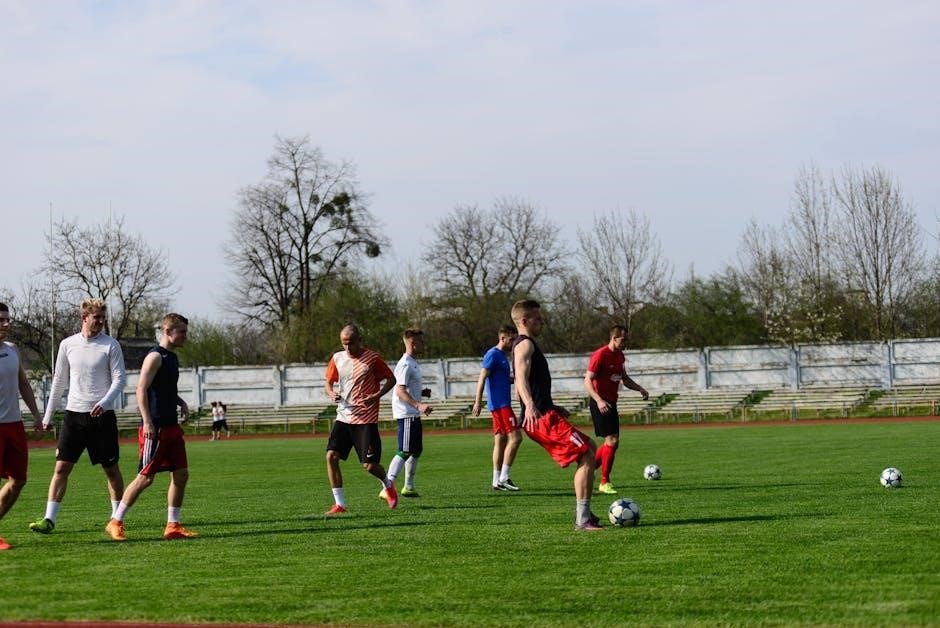
XII. Small-Sided Games (20 minutes)
Small-sided games are crucial for translating individual skills into tactical understanding and game intelligence. These games, played with fewer players on smaller fields, maximize touches on the ball and encourage quick decision-making in tight spaces. The emphasis shifts from isolated drills to applying learned techniques within a competitive environment. This phase of practice fosters creativity, problem-solving, and teamwork.
We utilize variations like 3v3 and 4v4, adjusting the field size and rules to suit the players’ age and skill level. Coaches observe and provide targeted feedback on positioning, passing patterns, and defensive organization. Games are designed to replicate common game scenarios, such as possession-based play, attacking transitions, and defensive recovery. Encouraging players to communicate effectively is paramount.
These games are not just about scoring goals; they’re about developing a deeper understanding of the game’s principles. We focus on creating a fun and engaging learning environment where players can experiment and take risks. Small-sided games bridge the gap between drills and full-scale matches, preparing players for real game situations. They are a vital component of a well-rounded training session.
XIII. 3v3 Possession Game
The 3v3 possession game is an excellent entry point into small-sided game play, focusing on fundamental principles of keeping the ball. Played within a defined grid (approximately 20×20 yards), the objective is for one team to maintain possession for a predetermined duration – typically one to two minutes. Teams rotate between attacking and defending roles, ensuring equal participation and varied experience.
Key coaching points include passing accuracy, quick decision-making, and supporting runs. Players are encouraged to use all surfaces of their feet to control and distribute the ball effectively. Emphasis is placed on creating passing lanes and moving off the ball to offer support. Defensively, players should focus on pressing as a unit, intercepting passes, and winning the ball back quickly.
To add complexity, coaches can introduce constraints such as a limited number of touches or requiring a certain number of passes before attempting to score (by passing the ball out of the grid). This game promotes spatial awareness, communication, and the ability to work collaboratively under pressure. It’s a fantastic way to improve technical skills while fostering tactical understanding in a game-like setting. Observe player movement and decision-making closely.
XIV. 4v4 Goal Scoring Game
The 4v4 goal scoring game elevates the intensity from the 3v3, introducing a greater emphasis on attacking creativity and defensive organization. Utilize a slightly larger grid (around 30×20 yards) with a goal at each end. Teams of four compete to score, focusing on quick transitions and exploiting space. Games are timed, with the team scoring the most goals declared the winner.
Coaching points should center around attacking combinations, off-ball movement to create opportunities, and effective finishing. Players should be encouraged to dribble with purpose, pass accurately, and support attacking runs. Defensively, emphasize tracking runners, closing down space, and winning tackles cleanly. Communication is vital – players must talk to each other to coordinate their movements.
Introduce variations like requiring a certain number of passes before shooting, or limiting touches within the attacking third. This encourages patience and thoughtful build-up play. Observe how players react to increased pressure and their ability to make quick decisions. This drill develops tactical awareness, passing range, and finishing ability in a competitive environment. Focus on encouraging risk-taking and creative play.
XV. Cool-Down & Static Stretching (10 minutes)
The cool-down is a crucial, often overlooked, component of any effective soccer practice. Begin with a light jog around the perimeter of the field for approximately 3-5 minutes, gradually decreasing intensity. This helps to slowly lower heart rate and prevent blood pooling in the legs. Follow the jog with a series of static stretches, holding each stretch for 20-30 seconds.
Focus on major muscle groups used during practice, including hamstrings, quadriceps, groin, calves, and hip flexors. Examples include hamstring stretches (touching toes or using a towel), quad stretches (holding your foot towards your glutes), and groin stretches (butterfly stretch). Encourage players to breathe deeply and relax into each stretch, avoiding bouncing or jerky movements;
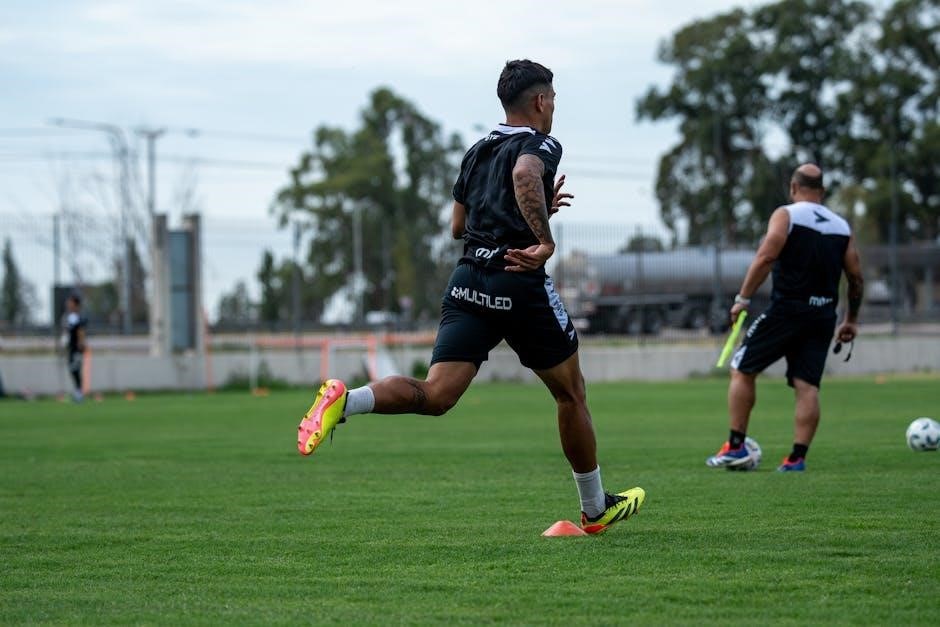
Proper stretching improves flexibility, reduces muscle soreness, and aids in recovery. This phase is also an excellent opportunity for coaches to provide individual feedback to players. Remind players of key learning points from the session and offer encouragement. A well-executed cool-down minimizes the risk of injury and prepares players for future training sessions. Prioritize recovery as much as performance!